
The last sporadic group falls: Team realizes M23 as a Galois group over the rationals
Forty years after the other 25 sporadic groups were settled, an explicit degree-23 polynomial shows that M23 is a Galois group over Q.
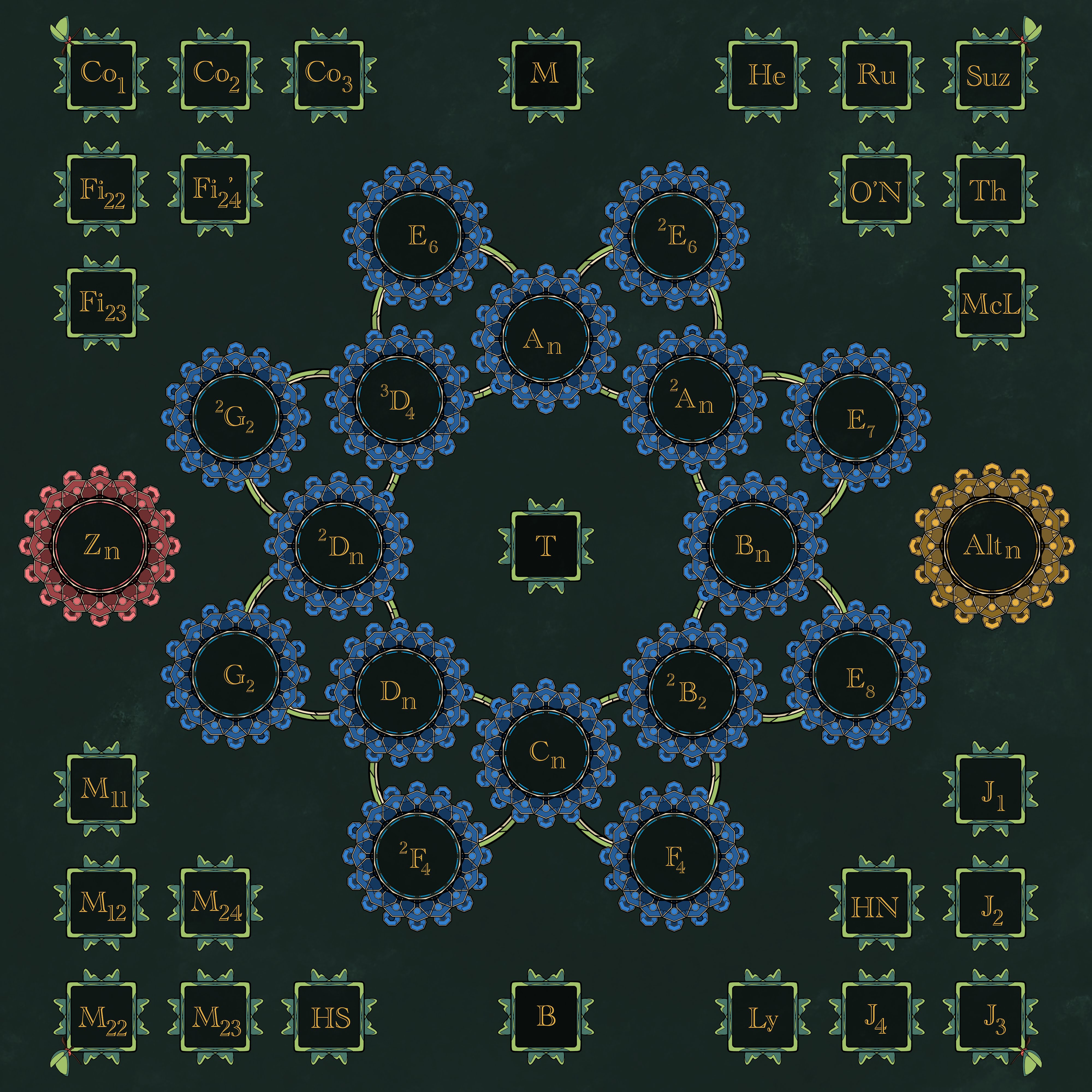
A team of mathematicians, including ICARM Innovation Engineer Blake Jackson, has resolved one of the most stubborn open cases of the inverse Galois problem, proving that the Mathieu group M23 occurs as the Galois group of a field extension of the rational numbers. Of the 26 sporadic finite simple groups, M23 was the only one whose realizability over Q remained unknown, and the question had been open for roughly four decades. The proof is fully explicit. The team produced a concrete degree-23 polynomial with rational coefficients whose splitting field has Galois group M23 over Q. AI involvement accelerated much of the work, particularly the computation.
The result, which includes a Q-regular realization over Q(t), was posted to the arXiv this week (arXiv:2608.08538). The authors are Xiaoyu Huang (Temple University), Blake Jackson (ICARM, Carnegie Mellon University), Kyu-Hwan Lee (University of Connecticut and Korea Institute for Advanced Study), Bjorn Poonen (Massachusetts Institute of Technology), Rachel Pries (Colorado State University), and Shaowu Zhang (California Institute of Technology).
Background
The inverse Galois problem asks whether every finite group arises as the Galois group of some extension of Q. The question dates back to Gauss in 1801 and remains open in general, but the rigidity methods developed by Thompson, Matzat, Malle, and others settled it for 25 of the 26 sporadic simple groups by the late 1980s. M23 has so far resisted the rigidity methods, and earlier attempts produced realizations only over quadratic and quartic number fields rather than over Q itself.
Mathematics in the age of computer-aided reasoning
The project began at the May 2026 workshop AI and Number Theory, organized by the American Institute of Mathematics (AIM) and supported by Innovation Engineers at ICARM. It is a good example of the kind of work the institute exists to support. LLMs were used to search the literature, generate code, quickly test hypotheses, check the results, and proofread the manuscript. Computation played a major role as well. All code accompanying the paper is publicly available at github.com/shaowuz/m23isgalois.